

Understanding the Increase in Fatal Hit-and-Run Crashes: Prevalences of Crashes, Injuries, and Deaths in the United States, 2017-2023
March 2026
Introduction
Previous research has shown that hit-and-run crashes are a major traffic safety problem, especially in crashes involving vulnerable road users. The objectives of the current study were to provide estimates of the numbers of hit-and-run crashes, injuries, and deaths in the United States in recent years, and to gain insight into the characteristics of fatal hit-and-run crashes as well as the drivers who flee from them. The current study analyzed data from a national database of all fatal crashes, as well as a representative sample of all police reported crashes regardless of severity. In addition, potential countermeasures to reduce hit-and-run crashes and gaps in knowledge are discussed.
Methodology
Crashes in which a driver left the scene (“hit-and-run” crashes) were examined using data from the National Highway Traffic Safety Administration. Data from 1975 (the first year of available data) through 2023 (most recent available data) were used to examine long-term trends in hit-and-run crashes that resulted in a death. The characteristics of hit-and-run crashes in recent years were investigated using data from 2017 through 2023. Hit-and-run fatalities and injuries were quantified overall and by road user type. Deaths were further examined in relation to environmental factors. The characteristics of hit-and-run drivers (i.e., the driver who left the scene), in cases where they were known, were also examined to provide insight into who leaves the scenes of fatal crashes.
Results
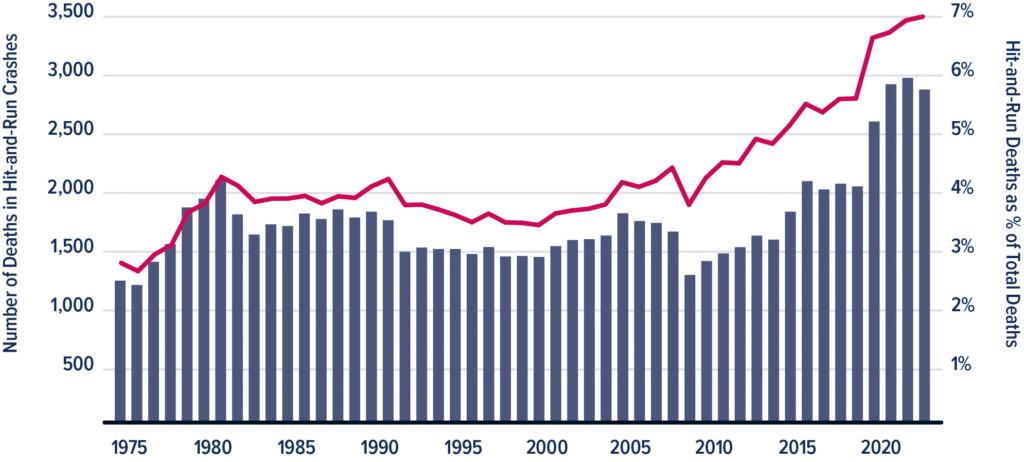
The annual number and percentage of traffic fatalities occurring in hit-and-run crashes has been increasing since 2010, spiked in 2020 (the first year of the COVID-19 pandemic), and reached an all-time high of 2,972 fatalities (7% of all traffic fatalities) in 2022. The absolute number fell slightly, but the percentage continued to increase, in 2023. (see Figure).
Approximately 1 in 10 injuries of people inside of vehicles occurs in hit-and-run crashes, resulting in over 200,000 vehicle occupant injuries in 2023. While fewer in absolute number, 1 in 5 cyclist injuries and 1 in 4 pedestrian injuries in 2023 occurred in a hit-and-run crash.
When looking at people killed in hit-and-run crashes, the disproportionate impact on vulnerable road users was even more extreme: more than 70% of people killed in hit-and-run crashes were pedestrians and bicyclists. Nearly 80% of all hit-and-run fatalities occurred in darkness. The proportion of fatalities that occurred in hit-and-run crashes was highest in the largest cities, decreased with city size, and was by far the lowest in rural areas. When examining a common measure of community social and economic vulnerability, the zip codes comprising the most vulnerable 20% of the U.S. population had more than 3 times as many hit-and-run fatalities as the middle 20%, and more than 6 times as many as the least vulnerable 20%.
Among drivers who left the scenes of fatal crashes and were eventually caught (slightly less than half of all hit-and-run drivers), the majority were young males and crashed within a short distance of their home zip code. Two in five lacked a valid license. More than half were driving vehicles they personally did not own.
The Research Brief provides additional data on the characteristics of hit-and-run drivers, crashes, and victims, as well as an overview of recent information on efforts to combat the problem of hit-and-run crashes.
Authors


Suggested Citation
Kasha, A. & Tefft, B.C. (2026). Understanding the Increase in Fatal Hit-and-Run Crashes: Prevalences of Crashes, Injuries, and Deaths in the United States, 2017-2023 (Research Brief). Washington, D.C.: AAA Foundation for Traffic Safety.
Related Content